Why AI pilots fail to reach production
TokenShift Executive Note
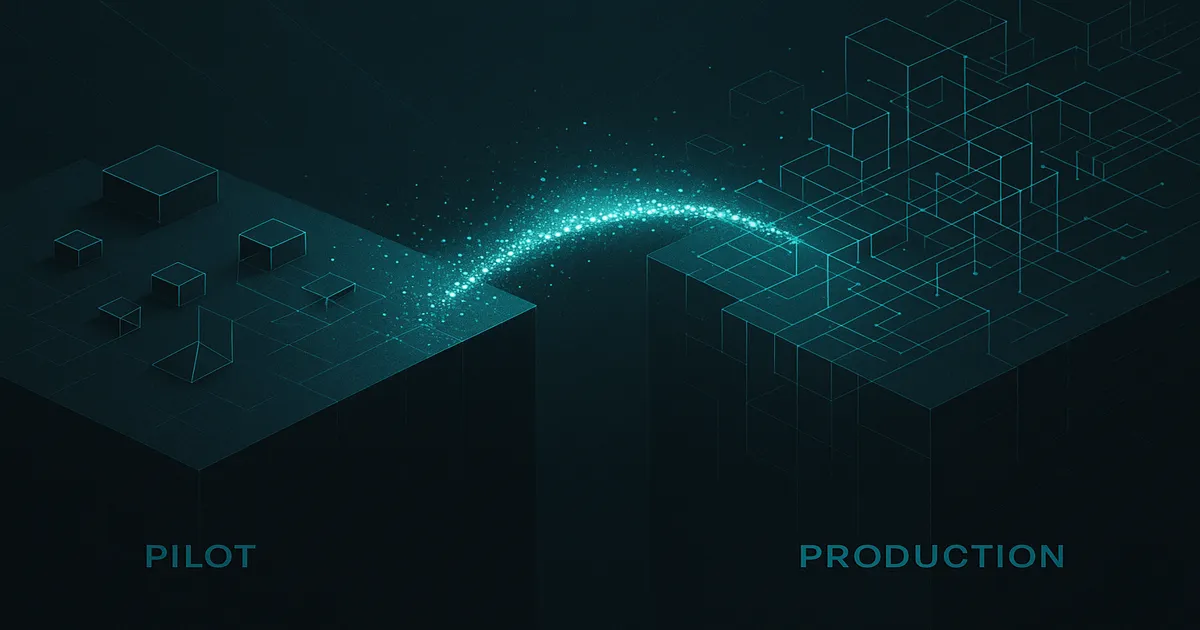
Why do most enterprise AI pilots never reach production? The answer is structural, not technical. According to a 2024 McKinsey Global Survey, 87% of organizations report experiencing skill gaps in AI adoption (McKinsey, 2024), and Gartner estimates that “through 2025, 85% of AI projects will deliver erroneous outcomes due to bias in data, algorithms, or the teams responsible for managing them” (Gartner, 2024). Most enterprises do not struggle with experimentation. They struggle with the handoff from isolated pilots to accountable production outcomes.
As Harvard Business Review has noted in its coverage of AI implementation challenges, the winning move is to align technology, operating model, and workforce decisions before scale pressure compounds. Yet most organizations do the opposite. They sequence these decisions linearly — build first, govern later, retrain last — and then wonder why the program never reaches steady-state production.
As Cassie Kozyrkov, former Chief Decision Scientist at Google, has observed: “The biggest risk in AI is not that it will not work. The biggest risk is that organizations will deploy it without the institutional capacity to know whether it is working.”
The three failure modes
After working with dozens of AI programs across European mid-caps, a clear taxonomy emerges. Pilot-to-production failure is not random. It follows one of three structural patterns. IDC projects that worldwide AI spending will reach $632 billion by 2028 (IDC Spending Guide, 2025), yet much of that capital is at risk of being stranded in programs trapped between these failure modes.
1. Architecture without governance
The technical team builds well. The data pipeline works. The model performs within acceptable thresholds. But there is no governance layer defining who owns the output, who monitors drift, who authorises retraining, or who escalates when the model interacts with a regulated process. The NIST AI Risk Management Framework makes clear that production AI requires continuous governance, not a one-time compliance review. Without it, the pilot sits in a sandbox while the organisation debates who should be accountable.
2. Governance without adoption
The compliance and risk functions have done their job. There is a policy framework, a risk register, perhaps even an ethics board. But the people who must change their daily workflows — the operations managers, the frontline teams, the business-unit heads — have not been brought into the program. The governance structure exists on paper while adoption stalls on the ground. This is the failure mode that creates the most frustration, because the organisation has invested in doing things “properly” and still cannot ship.
3. Adoption without ownership
The team is trained. Workshops have been delivered. Enthusiasm is real. But there is no named owner for production outcomes, no constraint library documenting what must be true for the system to operate safely, and no mechanism for escalation when reality diverges from the pilot assumptions. Adoption without ownership produces what looks like progress but delivers no durable value.
What “production-ready” actually means
Production-ready is not a technical milestone. It is an operating-model milestone. A system is production-ready when four conditions are met simultaneously:
- Technical readiness: The architecture can operate at target scale with acceptable latency, reliability, and cost. Infrastructure is not duplicated across shadow environments.
- Governance readiness: Ownership is mapped — not to committees, but to named individuals with authority and accountability. Risk thresholds are defined, monitored, and linked to escalation protocols.
- Workforce readiness: The people who must work with the system understand their changed roles, have been supported through transition, and can operate without reverting to legacy processes under pressure.
- Economic readiness: The business case reflects production economics, not pilot economics. Total cost of ownership includes adoption, monitoring, governance, and ongoing workforce support — not just compute and licensing. BCG Henderson Institute data shows that companies successfully scaling AI report 1.5x revenue growth versus peers (BCG, 2024) — but only when production economics are honestly modeled.
Most programs clear one or two of these conditions. The TokenShift method is built around the recognition that all four must be addressed in parallel, not sequentially.
The role of executive ownership
The single strongest predictor of pilot-to-production success is whether a named executive owns the production outcome — not the experiment, not the budget line, but the operating result. This is not a symbolic role. The production owner must have authority across technology, operations, and workforce decisions, because the handoff failures that kill AI programs always occur at the seams between these functions.
In practice, this means the executive sponsor must be able to answer four questions at any point in the program:
- What is the current constraint preventing the next phase from starting?
- Who owns resolving that constraint, and by when?
- What happens to the delivery timeline if the constraint is not resolved?
- What decisions need to be escalated to the board, and what is the recommended action?
If the sponsor cannot answer these questions, the program does not have executive ownership. It has executive visibility, which is a different — and insufficient — thing.
The constraint library concept
One of the most effective mechanisms for maintaining production momentum is a constraint library: a living document that catalogues every known blocker, dependency, and risk condition across the program. Unlike a risk register, which tends to be static and compliance-oriented, a constraint library is operational. It is reviewed weekly, updated by delivery teams, and used to drive executive decisions.
Each constraint entry answers three questions: What is blocking progress? Who owns the resolution? What is the deadline? When a constraint persists beyond its deadline, it escalates automatically. This removes the political friction that often prevents bad news from reaching the right decision-maker in time.
Next step:Book a Decision Clarity session to map ownership, constraints, and risk before committing more capital to your AI program.
What this means for your next decision
If your AI program is stuck between pilot and production, the diagnosis is almost certainly not technical. It is structural. The architecture may be sound. The data may be clean. The model may perform. But somewhere in the operating model — in governance, in ownership, in workforce readiness, in economic assumptions — there is an unresolved constraint that no amount of technical iteration will fix.
The most productive move is not to run another pilot. It is to conduct a Decision Clarity assessment that maps the four readiness dimensions against your current state, identifies the binding constraints, and assigns named owners with deadlines. That is the work that separates organisations that understand why AI programs fail from those that keep discovering the same failure in new disguises.