Forward Deployed Engineers: what this model actually fixes, and what it won't
TokenShift Executive Note
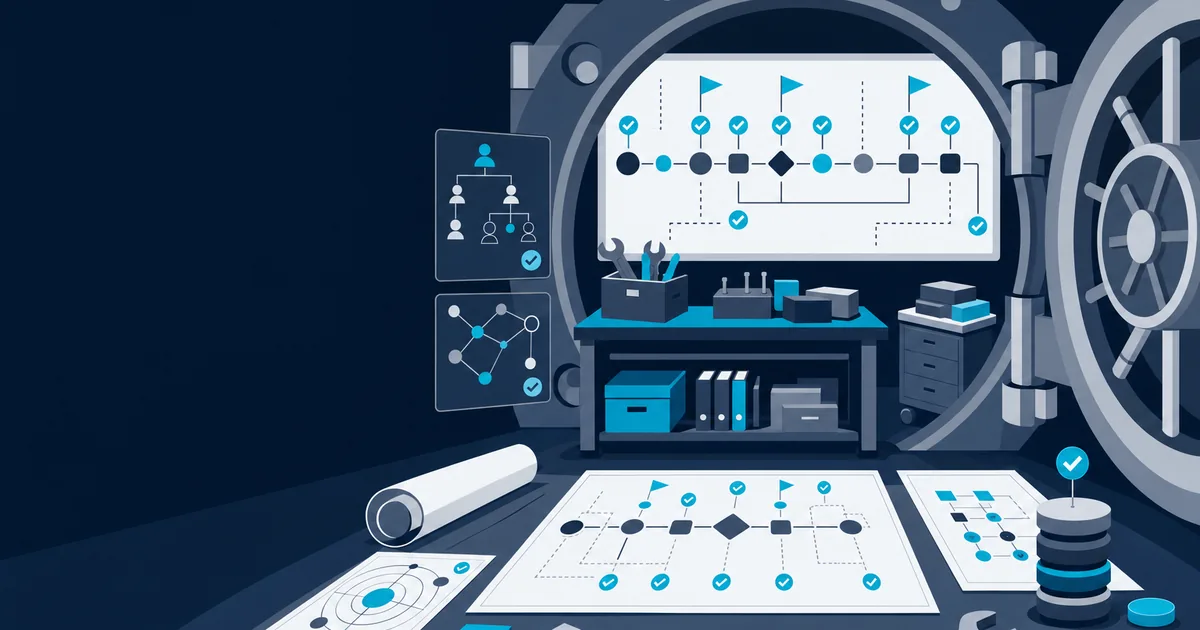
In May 2026, within a single week, the two leading AI labs did exactly the same thing: they stood up a dedicated services arm to place engineers inside their customers' organisations. This is not a commercial growth play, it is a verdict on how AI does — or does not — reach production. So for a European board, the useful question is not whether the Forward Deployed Engineer (FDE) is fashionable, but whether it fixes the problem your pilots failed to fix.
Where the role comes from, and why it is resurfacing now
Palantir invented the function in the mid-2000s, for government customers whose data environments were too sensitive and too idiosyncratic for remote delivery. The contrast with a solutions architect is sharp: the architect hands over a document, the FDE writes and ships code that runs inside the customer's system. Until 2016, Palantir employed more FDEs than conventional software engineers.
The economics that make the model viable have a name at Palantir: gravel road to paved highway. The FDE builds something rough, specific and fast; the core product team spots the patterns shared across several customers and turns them into standard features. Without that second half, all you have is a consultancy dressed up as a software vendor.
What changed is the evidence. The MIT NANDA study The GenAI Divide: State of AI in Business 2025, built on 52 executive interviews, 153 leader survey responses and an analysis of 300 public deployments, concludes that 95% of generative AI pilots produced no measurable effect on the P&L, and that only 5% of the tools assessed reach production. The bottleneck was never the model, it was getting it into use.
Hence the two announcements of May 2026. On 4 May, Anthropic, Blackstone, Hellman & Friedman and Goldman Sachs launched an AI-native services firm, a standalone entity with Anthropic engineering resources embedded directly, backed by General Atlantic, Leonard Green, Apollo, GIC and Sequoia. Days later, OpenAI created the OpenAI Deployment Company, a majority-owned subsidiary capitalised with more than $4 billion, in partnership with 19 funds, firms and integrators led by TPG, and acquired the London consultancy Tomoro to bring roughly 150 Forward Deployed Engineers and Deployment Specialists in from day one.
Passing fad, or lasting shift?
Both, and the two need telling apart. The "it's a technical consultant with a new badge" critique holds up whenever the role is badly framed; it has been circulating widely on engineering forums for two years. The serious signal lies elsewhere: in buyer-side demand.
An analysis published on 30 July 2026 by Echoloc, covering 4,817,533 live job postings from 836,718 companies, identifies 1,142 companies with an open AI leadership role. The density of those postings rose from 5.6 to 16.0 per 100,000 listings between Q4 2025 and Q2 2026 — a tripling in nine months. 69% of those companies are not technology firms; financial services lead the non-tech pack with 130 companies, ahead of insurers (40) and banks (29). A telling detail for any board: the titles "AI Enablement" (48) and "AI Transformation" (38) now rival "Director of AI Engineering" (28). Companies are not buying research; they are buying production.
The shift reaches Europe directly. In November 2025 Anthropic announced new offices in Paris and Munich, after tripling its EMEA headcount in a year, citing L'Oréal, BMW, SAP, Sanofi, N26, Qonto and Doctolib among its references.
What works: a five-step approach
1. Pick a workflow, not a use case. A use case gets demoed; a workflow has a volume, a unit cost and an owner. Name the P&L line before you name the model.
2. Write the evaluations before the code. OpenAI structures its client engagements in three stages: a few days of on-site scoping, a validation phase where evaluation criteria and quality controls are built, then delivery at several days per week on site. Phase 2 is the one companies skip, and it is the one that decides everything.
3. Staff a pair, never a solo. An FDE without a part-time business expert alongside will produce an elegant integration nobody uses. At Palantir, the embedded engineer is paired with a profile who maps the operational blockers.
4. Apply the third-time rule. Anything the FDE rebuilds for the third time becomes a reusable component; otherwise the road stays gravel and you fund bespoke work forever.
5. Plan the exit from day one. An FDE engagement succeeds at the moment the internal team takes over with no drop in service.
One documented example: an OpenAI FDE working with John Deere travelled to Iowa to design tailored interventions with farmers, working directly with end users. Translate that to insurance: the workflow for verifying supporting documents on a property claim, 40,000 files a year, a known average turnaround, a manual-rework rate measured before anyone intervenes. That level of granularity is what makes an FDE engagement decidable in an investment committee — not the slogan "deploy AI across customer service".
Mistakes to avoid
Mistaking an FDE for a fixed-price integrator. A simple test, borrowed from practitioners: ask how success will be measured. If the answer talks about milestones delivered rather than production adoption, you are buying conventional integration at frontier-engineering rates.
Deploying without a business owner on your side. The FDE is an accelerator, not a decision-maker. The hiring data bears this out: the market is recruiting adoption leaders first; the embedded engineer does not replace that role, it depends on it.
Forgetting the DORA register. A vendor engineer, embedded in your processes and writing production code, constitutes an ICT service under Regulation (EU) 2022/2554, in force since 17 January 2025; Article 28 requires maintaining the register of information on contractual arrangements, with the first official submission to authorities due by 31 March 2026. Plenty of FDE engagements start on a purchase order and never make it in.
Funding the engagement from the project budget. An FDE paid for by IT and assessed by IT will deliver a clean integration with no effect on margin. The budget has to come from the business unit that owns the workflow.
Reading the AI Act delay as breathing room. The Digital Omnibus package, adopted by the European Parliament on 16 June 2026 and approved by the Council on 29 June, pushes the obligations for Annex III high-risk systems (including credit, insurance and HR) from 2 August 2026 to 2 December 2027. Still applicable on 2 August 2026: the Article 50 transparency obligations, penalty powers of up to €35 million or 7% of global turnover, and the AI literacy requirement in force since February 2025. Whatever you put into production today with an FDE will have to document its compliance seventeen months from now.
Leaving the road unpaved. If nothing has been productised after two engagements, the model has failed, however happy the users are.
The observable markers to insist on
Six indicators are enough to tell whether an FDE engagement is holding or drifting:
- Week 4: a workflow running in limited production on real volume, not a demo.
- Reuse share: percentage of the engagement's code absorbed into standard components after three months.
- Manual-rework rate before and after, across the same set of files.
- Cost per file processed, against the baseline measured before kickoff.
- FDE person-days consumed per point of margin gained on the workflow.
- Entry in the ICT register and compliant contractual clauses, within thirty days of kickoff.
How the role will evolve
Three trajectories are taking shape, and they are not mutually exclusive. The first is absorption: incumbent integrators rebadge their consultants as "FDEs" and the value dilutes. The second is internalisation, already visible in the hiring data: 95% of the companies opening an AI leadership role today had never posted one before 2026, and those same companies adopt agent frameworks at 4 to 5 times the market baseline rate. The third is productisation: every pattern industrialised reduces the need for the next piece of bespoke work.
The reasonable bet is that the "Forward Deployed Engineer" title fades in two to three years, but the function survives under another name: workflow engineer, reporting into the business, measured on margin rather than delivery. What will disappear is the prestige FDE billed by the day with no knowledge-transfer clause.
The decision for your next board meeting
Pick a single workflow, with a known volume and unit cost. Name the business owner who will carry the result. Demand the evaluation criteria before a single line of code. Enter the engagement in the ICT register at signature. And set, from the outset, the date on which your internal team takes over. If any one of these five points cannot be filled in, the engagement is not ready, however talented the engineer on offer.
TokenShift works with European boards on moving AI from pilots to governed production.
Sources
- MIT NANDA, The GenAI Divide: State of AI in Business 2025 (2025): report
- OpenAI, OpenAI launches the Deployment Company (May 2026): openai.com; legal analysis of the deal: Cooley
- Blackstone, Anthropic Partners with Blackstone, Hellman & Friedman, and Goldman Sachs to Launch Enterprise AI Services Firm (4 May 2026): press release
- Echoloc, Who's Hiring Heads of AI (data as of 30 July 2026): study
- The Pragmatic Engineer, What are Forward Deployed Engineers, and why are they so in demand?: article
- First Round Review, So You Want to Hire a Forward Deployed Engineer: article
- Anthropic, New offices in Paris and Munich expand European presence (7 November 2025): announcement
- ACPR, FAQ on the DORA Regulation (EU) 2022/2554: acpr.banque-france.fr
Get the next executive notes by email
One note at a time on AI in governed production — governance, costs, compliance, execution. Double opt-in, unsubscribe in one click.
Prefer a PDF? Three guides, written from these notes for the executive committee: see the guides →